
A Dual-Purpose Breed of Distinction and Beauty
The world of fancy pigeons is rich with breeds of remarkable history and form, and among them, the Strasser pigeon stands out for its striking appearance and surprising utility. As you explore The American Pigeon Museum & Library (APM&L) in Oklahoma City, you may encounter this distinctive bird, a testament to centuries of selective breeding that harmonizes beauty with purpose.
Breed Overview: The Powerhouse with Polish
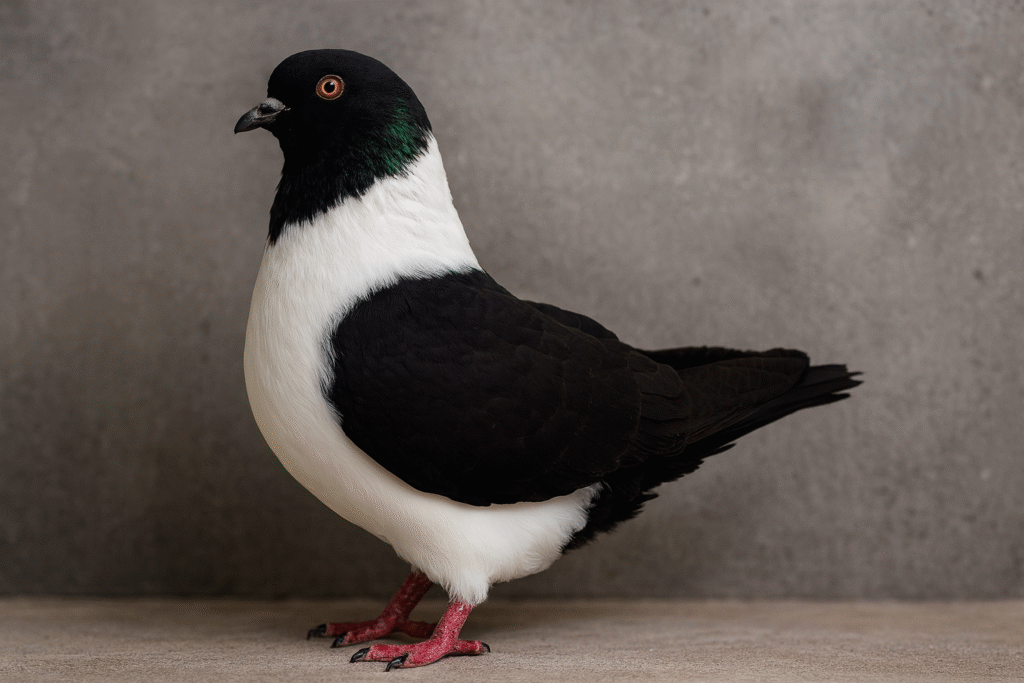
The Strasser pigeon is a medium to large breed, instantly recognizable for its bold and contrasting color markings. Its basic body color is white, while its head, a medium-sized “bib” on its neck, wings, back, tail, and anal plumage are vividly colored. This pattern creates a dramatic and elegant presentation.
Beyond its markings, the Strasser is bred to project a powerful, harmonious image. According to German breed standards, it should be massive, compact, and low-set with a broad, well-rounded head. The ideal bird, when viewed from above, should have the distinctive shape of a pear—wide at the shoulders and tapering towards the tail. It is a sturdy bird, with mature cocks typically weighing between 26 to 30 ounces and hens between 24 to 28 ounces.
A key feature is its eye, which should be a fiery orange-red. Breeders note that this eye color is often associated with more predictable breeding outcomes, though a deep ruby-red is also acceptable and equally prized in the show ring.
A Palette of Colors
One of the breed’s most captivating aspects is its variety. As of 2024, Strasser pigeons in Europe can be shown in an impressive 29 different color variations. These include:
- Standard Colors: Black, blue, red (recessive), and yellow (recessive), each appearing in patterns like barless, barred, checkered, or dark checkered.
- Dilute Colors: Silver (a dilute of blue) and ash-red or ash-yellow, also in various patterns.
- Decorative Patterns: More intricate patterns like “Toy Stencil” (white bars or lace on a colored wing) and “pencilled” markings.
This vast array means that breeders can pursue both the perfect form and a stunning spectrum of hues, making each Strasser unique.
A European Heritage with Practical Roots
The Strasser’s story began not in show halls, but on farms. The breed was developed in the 19th century in regions that are now Austria and the Czech Republic (historically Moravia). It was created through crosses of breeds like the Florentine, various Croppers, and field pigeons, with a primary goal: to be an excellent utility bird for producing meat squabs.
Its name is believed to be derived from the German word “Straße,” meaning “street,” hinting at its once-common presence in urban areas. However, its robust build and attractive markings soon caught the eye of fancy pigeon enthusiasts. Over decades, breeders refined the Strasser into the elegant exhibition bird we see today, without sacrificing its substantial size and hardy nature. This dual identity as both a utility and a fancy breed is central to its character.
The Modern Strasser: Breeding and Community
Today, the Strasser is especially popular across continental Europe, with dedicated breeding clubs in Germany, Austria, France, Hungary, and beyond. Germany is considered the contemporary center of Strasser breeding. Each year, the main German Strasser exhibition attracts over 1,000 birds and serves as a vital international meeting point for breeders to exchange knowledge and stock.
Successful breeding emphasizes the breed’s defining physical “wedge” shape and correct markings. The colored bib on the neck is particularly scrutinized; when a bird tucks its head, the bib should form a clean, egg-shaped outline. As natural and active breeders, Strassers are known for their strong parental instincts. A pair typically raises two squabs per clutch, sharing incubation and feeding duties.
The Strasser at The American Pigeon Museum & Library
The mission of the APM&L is to document the history of pigeons and their relationship with humans. The Strasser pigeon, with its clear evolution from farm utility to show-ring star, perfectly encapsulates this story of domestication and selective breeding.
Housed in its 6,000-square-foot building in Oklahoma City, the museum features exhibits on fancy pigeons, homing pigeons in war, and pigeon racing. Visitors have the unique opportunity to see live pigeons up close. The museum operates the “World of Wings” aviary, home to a flock of 200-250 pigeons, some of which may include striking breeds like the Strasser.
Seeing a Strasser in person allows you to appreciate what photos cannot fully convey: its imposing yet balanced stature, the satin-like sheen of its tight plumage, and its calm and docile temperament. It embodies the artistry of pigeon fanciers who, over generations, have shaped the rock dove into countless living works of art.
Whether you are a seasoned pigeon fancier or a curious visitor, the Strasser pigeon represents a fascinating chapter in avian history. It reminds us that human ingenuity can breed a bird capable of gracing both the family table and the champion’s podium, a true dual-purpose breed of distinction.
